Monday, February 7, 2011

Racism Affecting Future Generations

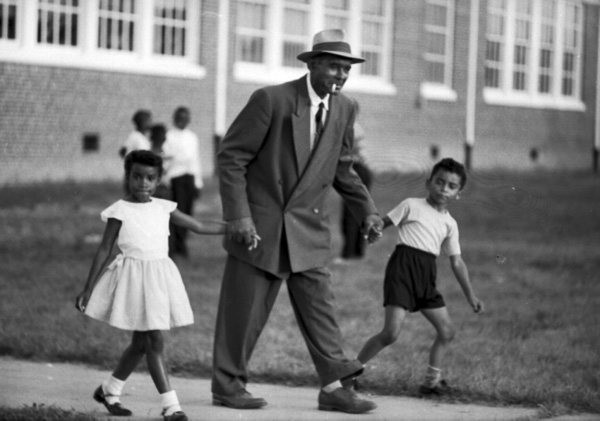
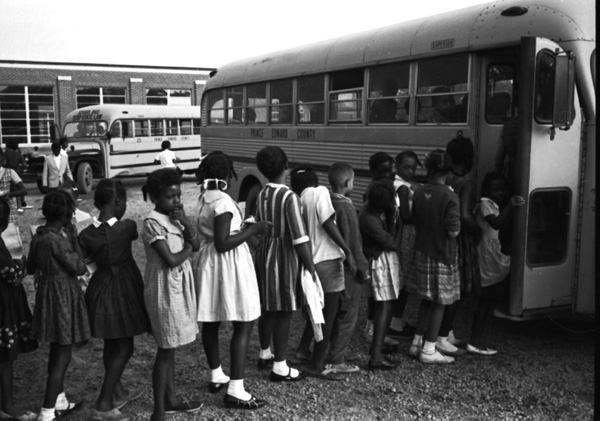
       In class today, Doc O'C quoted from a book he had recently read which chronicled the white and black migrations from and to the city in the earlier half of the 20th century. There was a section which mentioned Prince Edward County, in Virginia. The entire county shut down all of their public schools following unsuccessful attempts to find a way around the historic 1954 Supreme Court ruling in Brown vs. Board of Education. Many white children attended private schools, and many African-American children were bussed miles away, or did not attend school at all.
Students boarding a bus in 1964
       Not only was this a disservice to the communities, both black and white, of that generation, but a glance at the current economic conditions of the county in 2011 reveals how the sons and daughters were affected by this childish solution to an inexistent issue. A staggering 18.9% of the population, according the 2000 census, lives in poverty. There is no doubt a correlation to the county's embarrassing, sad history.
       When a situation like this is mentioned ("I can't have it my way so no one can have it all"), a child throwing his cake on the floor because he doesn't want to share comes to mind, or a cheesy movie in which the bad guy kills the girl because he can't have her. The decision to shut down the Prince Edward school county system was a puerile reaction to a federal law, and continues to negatively affect the community.

Monday, January 17, 2011

Semester Reflection: What Went Wrong?

I recognize my blogging has gone way down in quantity, and from what you may observe, quality, since first quarter ended so many weeks ago. There is really no explanation for my lack of blogging, an act which would normally consume about 10-15 minutes of my week.
       As far as lame excuses go, "not being inspired/having a desire" to blog is pretty high up there. But honestly, when it came time for me to dedicate myself for those daunting 15 minutes every Sunday afternoon, I could not dig out a topic in my mind that I felt passionate enough to write an honestly worded post about. Perhaps that is only an excuse I am inventing in my own mind now, as the semester draws to a close, but it really sums up my attitude towards this assignment in general.
       That being said, I recognize that I am a student of this AiS class, and have missed the equivalent of several assignments. I have choice on the curriculum, and understand that a grade must be given based on all aspects of my work in this course, and that my grade may reflect my lackadaisical attitude.
       I will apply myself much more to my blog this second semester and third quarter; a fresh start will encourage me to more to work on the assignment. A sample of my work from this quarter can be seen here: http://shotsfrommyblog.blogspot.com/2011/01/who-is-real-authority-on-childhood.html. It is probably worse than many of my first quarter posts.

Monday, January 10, 2011

Who is the Real Authority on Childhood?

       As our American Studies class continues our discussion on a child's development, and when it childhood actually ends, a new point has snuck into my mind: who are we (about 45 high school juniors, and 2 high school educators) to discuss what defines "childhood," and more specifically, the childhood of others? Obviously, our wandering discussions have no bearing on the lives of others, but can each person speaking in the room truly say that they are a decent, or even reliable, source on a child's development into adolescents? I believe no researcher, student, small child, or anyone else can speak general truths about "childhood."
       It is interesting how the common public puts so much faith in the research of aged PhDs when it comes to child research. They are the ones furthest from childhood in their life; and perhaps the least understanding of what modern childhood is like. One of the top groups in this field is the Society of Research in Child Development. Upon quick inspection of their home page, they do not seem to market themselves as a site friendly to the casual online viewer, or even child. This apparent lack of concern for their research topic is understandable; the average child or new mom would not look at this page for their own interest.
       A child could not claim to be an authority on childhood; they cannot fully express the complex emotions they are experiencing at their age. I am speaking only in regard to approximately ten year olds, but even after the age emotions become such a clutter in the teenage years.
       The only fair age to analyze youths is... none. Although many will formulate opinions on childhood, no definite facts/generalizations can be accredited by anyone of any age.


Monday, October 25, 2010

Reflecting on First Quarter


  Although I have noted almost no change in myself physically or mentally these last 8 weeks, my exposure to the online realm of digital information has expanded extraordinarily. My use of the internet has been transformed from a purely informational/entertainment source into a world of opinions and individuals. I have developed a sense for communication through this media from virtually nothing, and my improvement in the blog format has clearly shown that.
       My first post, dated the 6th of September, is as visually appealing as it is casual-- that is to say, very little. The mass of words organized with precise, neat margins down the side and no indentations is troubling to the eyes, the reader is would lose interest in a post so bland very quickly.
      Also, the writing style is uninteresting. The last 11 lines are consumed by 2 sentences, which drone on, and though thoughtfully written, do not create the same literary punch as deliberate, short sentence.
       I corrected this aspect of my blogging in later posts, such as my post regarding textbooks on October 3rd. Two sentences in this article truly embodies have I have corrected this area of my blogging, "As a liberal, I am morally disturbed by this claim. As an American, I am appalled."
This simple change has made my posts easier to read, and hopefully more enjoyable to the reader.
     While I have put effort forward in my blog posts, I understand that there is much left to be desired. For one, my recurring political topics are probably uninteresting to many of my classmates, and unless they are more polarizing in the future, they don't generate much discussion.
       Another aspect I will work on in the second semester is posting more frequently, and casually. Ideally, I will try to post several times a week, about minor things we discussed in class, there by generating more conversations. 

Here is a sample of one of my better posts:
Monday, October 18, 2010

Reliability of Authors

Rupert Murdoch, president of
News Corporation

Any firsthand account is bound to have some sort of inaccuracy, as humans are inherently imperfect when it comes to their own memories. The account of Frederick Douglass' life that we are currently reading in AIS is most likely not the one many who lived with him and "owned" him would give, and it was written for the consideration of abolitionists. No one was hiding the fact that the piece was unbiased, or that it served a purely informative purpose, rather that it was meant to be expositional and persuasive.
There are media outlets that exist today that portray themselves as informational, when in reality they serve more the purpose of Frederick Douglass' narrative. Recently, Fox News' donations to several Republican groups has taken them out of the strictly informational realm, and has given concrete evidence to what many American cable viewers have long suspected.
While I was never a fan of this station, the commentators were free to speak whatever was on their minds, and claim no affiliation to any one political party. Now that their paychecks and massive donations to conservative political organizations are coming from the same source, it is hard to dispute their unbiased view of politics. 
Fox News has left any notion of the informational realm aside, and entered into a purely political arena.

Sunday, October 3, 2010

Who controls how we learn about the past?

A mock textbook cover? No.
The state of Texas is known for being big. In physical size, population, and larger-than-life characters, Texas appears more like a small nation. One aspect of Texas' influence, which comes with its massive size, is its ability to influence the material taught in schools nationwide. Our AIS discussions regarding textbook bias is manifested in a recent vote, in which the Texas Board of Education voted on new standards regarding American history and how it ought to be taught. 
Cesar Chavez: Not significant enough
for textbooks?
This topic was fresh in my mind because of a recent article which appeared in a magazine I was reading. The new standards contained ideas of America being a "Christian land governed by Christian principles," as one board member put it. As a liberal, I am morally disturbed by this claim; as an American, I am appalled. 
The reason this was such a landmark decision because Texas has the largest textbook market in the nation, and publishers are heavily influenced by what material must be included. While the article did say that other states nationally would be minimal, neighboring states would feel the pressure to purchase the sam textbooks as Texas, for cost and accuracy. This is a total miscarriage of the process of education, and I am personally in favor of a national governing body to dictate the content of textbooks. 


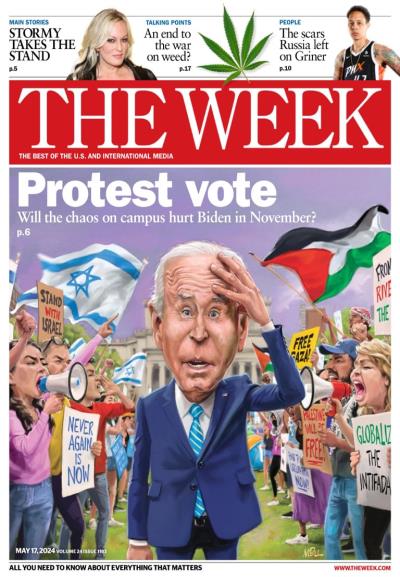
I'll conclude this discussion with a plug for a favorite magazine of mine: The Week. My aunt first sent me a gift subscription about two years ago, and since then I've been an avid fan of its unbiased view of national and world events. Instead of having staff writers, The Week has a team of editors who summarize the best articles from national and global news outlets, and extract phrases and sentences from those articles within the summary. The end result is usually a short, to the point three paragraph article, with a two polar voices and a moderate commentator's opinion. The format is genius, and I recommend this magazine to anyone with an interest in fairness and world events.
a recent copy of "The Week" magazine