Monday, April 11, 2011

"American" Label Sells on Television

Recently, over spring break, I had a whole cloudy, 45 degree day ahead of me, so, naturally, I flipped on the television and watched whatever might draw my eye first. Luckily for me, there was a Pawn Stars marathon, which happened to be a show I watched with some frequency. Pawn Stars (of the History Channel) follows the owners of the Gold & Silver Pawn Shop in Las Vegas; the Old Man, a cranky, squinty-eyed naval veteran, his son, Rick, an intelligent bald man with a desire to make money, his son, Corey, or "Big Hoss," and his friend, Chumlee, who provides comic relief.
       The show is also aided by a host of historical experts of their respective fields, who are often called in to analyze the value of strange items the sellers bring to the store. While many items are very old and rare, the ones that attract the most value to Rick, who is really the main buyer, are items of important value to American history.  Aside from directly saying this, Rick has numerous experts for elements of American history to call in, while he may only have one European history expert, one watch expert, and one toy expert. In some cases, he may call in both a weapons expert, for example, and an American historian.

Rick Dale: Who is more American?
       Also, I considered the other shows airing on the History Channel--an ad appeared very often during this Pawn Stars marathon. When Rick and Co. purchase a beat up, old item, they head to their buddy (other) Rick's shop where Rick Dale restores these old items of American importance. He relishes old Coca-Cola advertisements, and anything else relating to American culture--thus, his own spin-off show "American Restoration." 
     With a title as blatantly patriotic as that, there is not doubt that the History Channel is attempting to capitalize on the "American" brand. It is clear that they have had success with similar shows, like "Only in American with Larry the Cable Guy," and they want to continue that theme with the rest of their programming.
Maybe him?

Monday, March 21, 2011

Prison Research

I have been fortunate enough to select a topic which I am interested in, know little about, and one that there is a plethora of information about. The American prison system has become a beast that represents the waste associated with large government control. However, I have been discovering that the causes behind the United States increase in prison population, which is blowing up at over 13 times the growth of the overall population, is a product of many factors.
     While I have yet to come to a conclusion (a conclusion which may take several weeks), I have come to realize through at least a couple of scholarly articles that the fuel to this costly system is driven by poverty. While I believe my research, at this point, is on target, I know there is lot more information to sift through.

Friday, February 18, 2011

Triggers for Social Movements

       Our discussion in class yesterday revolved around how major news stories become major--the question posed by Mr. Spiro Bolos was, "Why has gay marriage become an issue?" It's an interesting question to ask, and a more difficult one to answer, because as of now there has been no trigger event for this movement, that I can identify, in the last ten years. There has been no national protest against gay marriage (as in tens of thousands lined up in the street spewing hateful language) that I can specifically call to mind, and although they undoubtedly exist, I cannot put a face to a national movement in favor of gay marriage.
       Several students theorized that the process of revolution and advancement of issues such as gay marriage was cyclical; there would be a build-up for a while, followed by a "trigger"event, and then focus on that issue would skyrocket. The issue would remain "hot" for an amount of time, fall out of conversation, and the cycle would repeat itself. I believe this is not the case, as the examples cited by my classmates were unconvincing to me (the Scientific Revolution, the French Revolution), but I do believe a trigger must occur for a full-fledged movement to take place. There is no face to gay marriage right now, and until there is, as with all movements towards social justice, it will be more difficult to receive attention for it.
 

Monday, February 14, 2011

Depictions of Unintelligent Women in Film and Literature

Recently, I was watching a James Bond film, Diamonds Are Forever (1971), and considered all the female characters involved. I also considered Doc OC's challenge posed to the class -- that throughout our reading of Adventures of Huckleberry Finn, where might we find an intelligent, or even a positive, portrayal of a developed female character.  
Bambi and Thumper, at the mercy of James Bond
       There were only 4 total female roles in Diamonds: Tiffany Case, Bond's beautiful female partner, played by Jill St. John, a well-known "Bond girl;" Plenty O'Toole, a well-endowed, mindless girl who struts about the craps table on the arms of whatever handsome man she can find, and who is thrown into a pool topless; and then two scantily-clad women, Bambi and Thumper,
who attempt to use elaborate gymnastics to kill James Bond, but both end up being dunked in a pool continuously by Sean Connery, and readily reveal the location of their evil boss.
       There is no role in this film for a strong female lead, but that has a lot to do with the genre of film and the anticipated audience. Women have their piece of eye candy to ogle over in Sean Connery, and the average man's movie-going experience is highlighted by scenes of fighting and violence, as well as sexual scenes with the likes of Plenty O'Toole (in its own, a name that doesn't necessarily give a off a strong, independent feel). The purely physical value of Plenty is highlighted in this clip. 
       A depiction of a female in a role like this is reminiscient of a "Hair Lip"-type charcter in Huck Finn; a women inserted for mere comedy, and no more.

Monday, February 7, 2011

Racism Affecting Future Generations

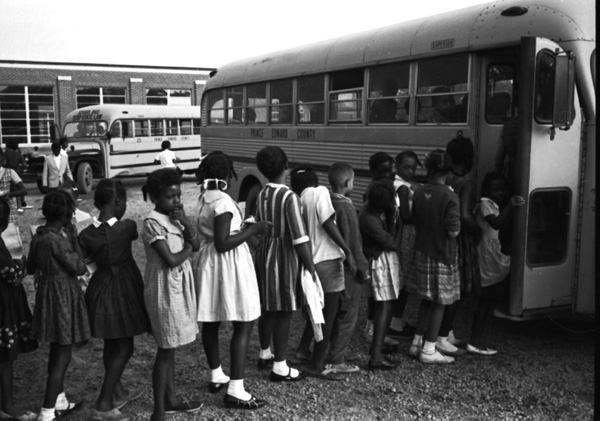
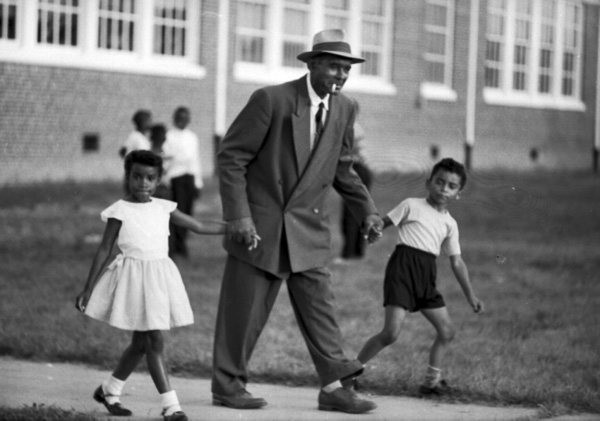
       In class today, Doc O'C quoted from a book he had recently read which chronicled the white and black migrations from and to the city in the earlier half of the 20th century. There was a section which mentioned Prince Edward County, in Virginia. The entire county shut down all of their public schools following unsuccessful attempts to find a way around the historic 1954 Supreme Court ruling in Brown vs. Board of Education. Many white children attended private schools, and many African-American children were bussed miles away, or did not attend school at all.
Students boarding a bus in 1964
       Not only was this a disservice to the communities, both black and white, of that generation, but a glance at the current economic conditions of the county in 2011 reveals how the sons and daughters were affected by this childish solution to an inexistent issue. A staggering 18.9% of the population, according the 2000 census, lives in poverty. There is no doubt a correlation to the county's embarrassing, sad history.
       When a situation like this is mentioned ("I can't have it my way so no one can have it all"), a child throwing his cake on the floor because he doesn't want to share comes to mind, or a cheesy movie in which the bad guy kills the girl because he can't have her. The decision to shut down the Prince Edward school county system was a puerile reaction to a federal law, and continues to negatively affect the community.

Monday, January 17, 2011

Semester Reflection: What Went Wrong?

I recognize my blogging has gone way down in quantity, and from what you may observe, quality, since first quarter ended so many weeks ago. There is really no explanation for my lack of blogging, an act which would normally consume about 10-15 minutes of my week.
       As far as lame excuses go, "not being inspired/having a desire" to blog is pretty high up there. But honestly, when it came time for me to dedicate myself for those daunting 15 minutes every Sunday afternoon, I could not dig out a topic in my mind that I felt passionate enough to write an honestly worded post about. Perhaps that is only an excuse I am inventing in my own mind now, as the semester draws to a close, but it really sums up my attitude towards this assignment in general.
       That being said, I recognize that I am a student of this AiS class, and have missed the equivalent of several assignments. I have choice on the curriculum, and understand that a grade must be given based on all aspects of my work in this course, and that my grade may reflect my lackadaisical attitude.
       I will apply myself much more to my blog this second semester and third quarter; a fresh start will encourage me to more to work on the assignment. A sample of my work from this quarter can be seen here: http://shotsfrommyblog.blogspot.com/2011/01/who-is-real-authority-on-childhood.html. It is probably worse than many of my first quarter posts.

Monday, January 10, 2011

Who is the Real Authority on Childhood?

       As our American Studies class continues our discussion on a child's development, and when it childhood actually ends, a new point has snuck into my mind: who are we (about 45 high school juniors, and 2 high school educators) to discuss what defines "childhood," and more specifically, the childhood of others? Obviously, our wandering discussions have no bearing on the lives of others, but can each person speaking in the room truly say that they are a decent, or even reliable, source on a child's development into adolescents? I believe no researcher, student, small child, or anyone else can speak general truths about "childhood."
       It is interesting how the common public puts so much faith in the research of aged PhDs when it comes to child research. They are the ones furthest from childhood in their life; and perhaps the least understanding of what modern childhood is like. One of the top groups in this field is the Society of Research in Child Development. Upon quick inspection of their home page, they do not seem to market themselves as a site friendly to the casual online viewer, or even child. This apparent lack of concern for their research topic is understandable; the average child or new mom would not look at this page for their own interest.
       A child could not claim to be an authority on childhood; they cannot fully express the complex emotions they are experiencing at their age. I am speaking only in regard to approximately ten year olds, but even after the age emotions become such a clutter in the teenage years.
       The only fair age to analyze youths is... none. Although many will formulate opinions on childhood, no definite facts/generalizations can be accredited by anyone of any age.